What the 30-minute estimate means
The official Steam page describes Combolands as a compact strategy game designed for 30-minute bursts. A launch-day InsertCoins review independently reports roughly thirty minutes for a run. Together, those sources make 30 minutes a reasonable planning number.
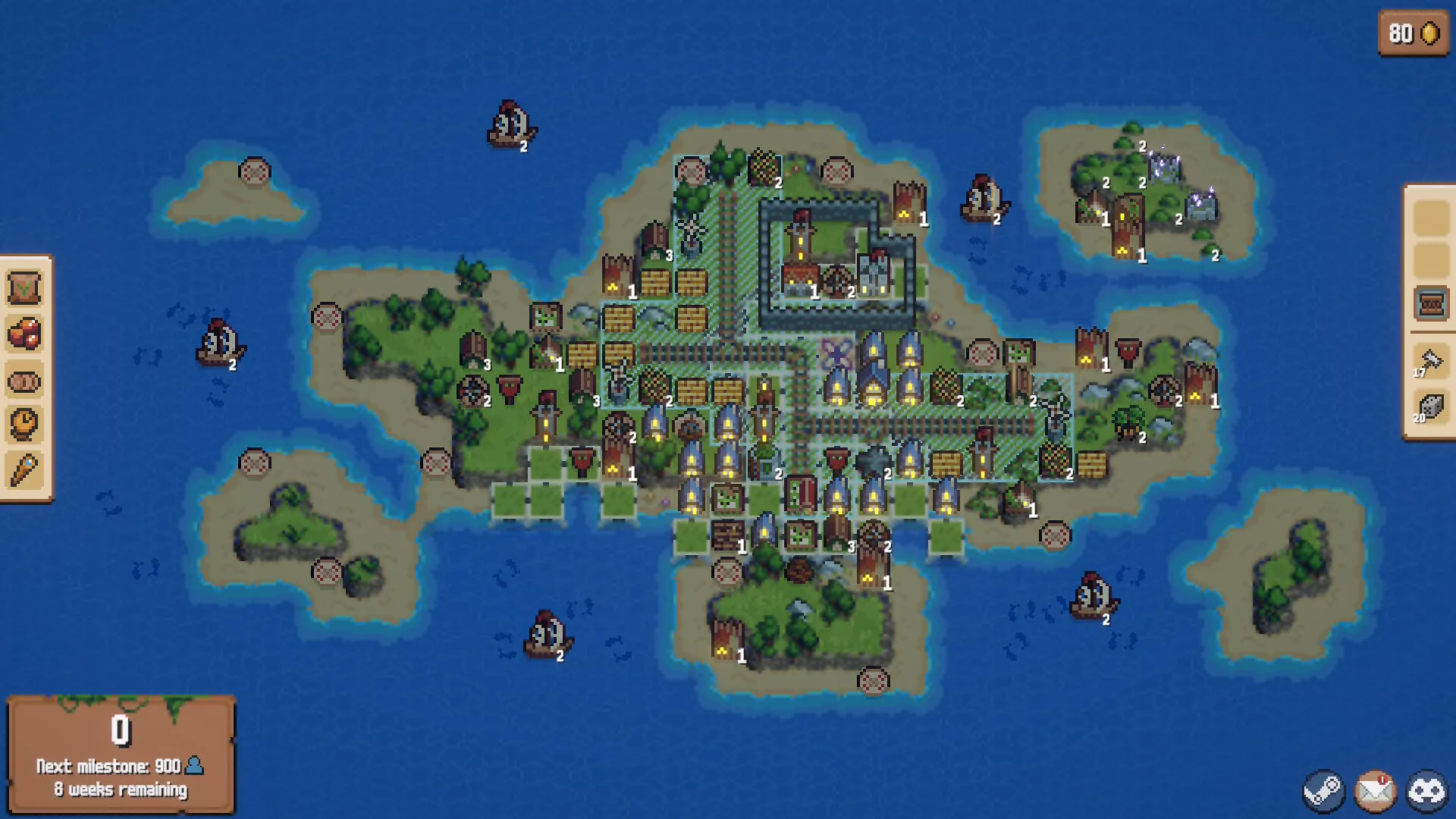
It is not a countdown shown in real minutes. The run interface uses weeks and population milestones. Reading unfamiliar cards, comparing placement previews and planning a large combo can make your real session shorter or longer than the estimate.
Run time is not total completion time
| Goal | Useful expectation | What it includes |
|---|---|---|
| One normal run | Plan about 30 minutes | Choosing Guilds, placing buildings and reaching population targets |
| Learning a new system | May take longer | Reading cards, tooltips and placement previews |
| Finishing every unlock | Many runs | Ranks, Guild combinations, buildings, heirlooms and achievements |
Why some public videos are much longer
A long video is not automatically evidence that one run lasts that long. Videos can contain setup, explanations, retries, multiple runs or extended play. Use the 30-minute figure for scheduling a normal session, then allow extra time when you are learning cards or deliberately testing a build.
How milestones affect the session
Official screenshots show a population target and weeks remaining. Demo v9 also added a progression unlock that lets eligible players choose whether reaching a milestone ends it immediately. The official note does not publish a universal reward for waiting, so the practical decision is to compare the value of more placements with the risk of missing the week limit. See the milestones and weeks guide for the step-by-step check.
How much time should you set aside?
For an Endless session, watch the time to resolve a week
The full-release Endless discussion, read October 1, contains extended Metropolis and Megalopolis runs. NCDarkness reports increasingly slow weekly calculations, puschelbubu reports roughly two minutes per week in one run, and TNS4Life reports roughly five minutes in another. These are different builds and machines, not a benchmark or a promise that yours will take the same time.
Do not interpret XXXV as a confirmed hard cap. Doombringer explicitly corrected that claim: their report concerned a milestone target turning negative, not a programmed end. Other players describe different late-stage glitches, freezes and very long calculations. Those reports justify caution, not a universal current-build limit or a recommendation to pursue an overflow.
- Set a real-time stopping point. The normal-run 30-minute estimate does not budget an extended session.
- Watch weekly calculation time. If a once-quick turn becomes progressively slow, allow extra time before committing to another milestone; do not immediately assume a save was lost.
- Stop at a checkpoint when practical. The Save and Continue guide explains the reported milestone transition and distinguishes it from losing completed stages.
- Record a repeatable stall. Note version, stage, map fullness and the transition that failed. Players suggest hazard spawning on a full map as one possible cause in some runs; it is not a diagnosis for every freeze.
Repeated-trigger builds can produce huge numbers without making the session shorter. Use the scoring guide to build an engine, but judge whether another hour of calculations serves your goal. The cited thread has no verified general recovery procedure for a late-run freeze.
For a normal first run
Set aside 30–45 minutes for an early run so you can read the interface without rushing. The extra buffer is planning advice, not a published game duration. Once card and placement rules are familiar, the official 30-minute rhythm becomes a more useful expectation.