
What makes a roguelike deckbuilder?
The shared structure is a run in which repeated choices change a temporary pool of cards, symbols or placeable objects. Failure or completion resets much of that run, then a new attempt asks you to build a different engine from uncertain rewards. The genre stops being useful as a recommendation label when every game is treated as another Slay the Spire.
Choose Slay the Spire for direct card combat
Slay the Spire is the straightforward choice when “deckbuilder” means drawing attacks, skills and powers against enemies. Its route, rewards and relics change from run to run, but the central question remains whether the deck can answer the next fight. Wildfrost adds more positional timing, while Monster Train 2 spreads defense across three vertical tiers.
Choose Balatro or Luck be a Landlord for a score engine
Balatro uses familiar poker hands as the input to a scoring system transformed by Jokers and other modifiers. Luck be a Landlord replaces the hand with slot symbols that interact automatically as rent rises. Neither asks you to trade attacks with a conventional enemy, so both suit players who enjoy compounding mathematics more than combat sequencing.
Our games like Balatro comparison separates casino cards, score engines, combat decks and spatial alternatives in more detail.
Choose Combolands when the deck should build a place
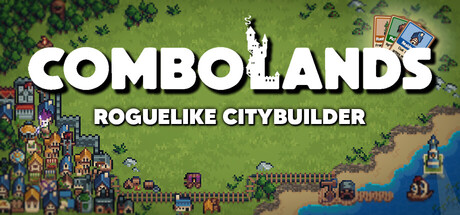
Combolands turns the run into an island town. Building cards are placed on a map, and the useful question is not only what a card does but where it sits relative to other buildings. That makes it a genuine roguelike deckbuilder with a different decision surface: the deck becomes a city rather than a hand of attacks.
If that branch is the reason you are here, compare card-based city builder games or open the Combolands beginner guide before choosing.
Choose Loop Hero when cards should build the world
Loop Hero places terrain, enemies and resources around a route while the hero moves and fights automatically. The player constructs the conditions around each expedition, then uses recovered resources to expand a persistent camp. It sits between a deckbuilder, an automatic engine and a settlement-progression game.
Choose Inscryption for a deck wrapped in mystery
Inscryption combines deckbuilding with escape-room puzzles and psychological horror. It is the least useful choice here if you only want a repeatable systems sandbox, but the strongest fit when the card game should keep revealing new narrative layers.
How this list avoids false matches
A game appears here because its official description supports a run-based card, symbol or placement engine—not merely because it uses the word roguelike. The comparison also states where each game diverges. That boundary matters most for Combolands: it belongs in the genre, but it does not promise poker hands, dungeon combat or a Slay the Spire clone.