Beginner guide and tips
How to play Combolands: 10 tips for your first runs
Read the population target and weeks first. Scan the offered building cards, compare the placement preview, spend Gold and pursue Council quests with a purpose, then reach the target before the in-game week counter expires.
On this page
10 decisions that improve almost every run
These are flexible checkpoints rather than one forced build order.
| Tip | What to do | Why it matters |
|---|---|---|
| 1. Read the target | Check population and weeks before placing. | A good engine that matures after the timer is still a losing plan. |
| 2. Scan the whole hand | Compare every offered building before committing space. | The deckbuilder loop limits the choices available now. |
| 3. Use the preview | Move the placement preview across several tiles. | Score-preview fixes in v1.0.3 show that the displayed preview is part of the intended decision loop. |
| 4. Leave trigger space | Keep open tiles around range and adjacency engines. | Later buildings may need to enter, leave or trigger inside that area. |
| 5. Build one loop first | Make one direct interaction reliable before chasing several partial combos. | Composter + Manure is the clearest documented example. |
| 6. Give Gold a job | Reserve it for a quest, shop route or unlock target. | Refresh and dismiss costs can consume the economy without advancing the run. |
| 7. Match the support Guild | Use Civic for councillor access or Martial for repeat triggers when Commercial is your economy base. | Public full-release guides use both routes for secret-Guild attempts. |
| 8. Read live item text | Check the tooltip before relying on a remembered Demo value. | Demo balance remains useful history, not automatic launch truth. |
| 9. Finish unlock runs | Complete the run before Endless mode when pursuing a Guild or achievement. | Community reports show some end-screen and achievement unlocks register only after the run or a restart. |
| 10. Learn from the result | Note which card, space or currency bottleneck ended the run. | Ranks increase pressure, so the same weak point will matter more later. |
What kind of tutorial should you expect?
Combolands includes guidance, but the light-touch approach is intentional. In a Steam reply marked [developer], Crux Games said the full game has a little more directed tutorialization than the demo, while deliberately not telling players exactly which building to place in each position. Use the steps below as a decision checklist rather than a fixed build order.
Your first run, step by step
1. Read the target before placing anything
The interface shows your current population, the next milestone or final target, and weeks remaining. One official Demo v7 screenshot shows 300 population, a 3,000 next milestone and 7 weeks remaining. Another pre-release screenshot shows a 6,500 target with 8 weeks remaining.
2. Treat the bottom row as your building-card hand
The official Small City screenshot visibly offers Windmill, Magic Plaza and Herb Garden as three cards. The store describes Combolands as a deckbuilder: your immediate choice comes from the offered buildings, not from a permanent free-build catalogue. Use the Combolands buildings list to separate documented effects from names and balance fragments.
Repeated opening cards are not necessarily lost unlocks: full-release players describe a restricted early pool that expands with milestones. Use the building-card pool guide to plan the opening instead of rerolling for a late blueprint too soon.
3. Check placement relationships
Range, adjacency and removal can all change value. First learn how to read the blue adjacency and orange range areas, then check whether the card has a separate range placement restriction. Demo v9 says Composter gains farm multiplier when a building in range is removed and automatically removes adjacent Manure. Use the building interactions tool before committing scarce space.
If a multiplier rises but your points do not, use the scoring guide to identify the missing scorer or trigger before adding more modifiers.
For a Maritime opening, the Kelp Field and Seaweed Farm guide separates useful Fishing Boat placement from an assumed direct seaweed combo.
4. Keep Gold tied to a purpose
The Small City screenshot shows 385 Gold and a Sell Items action. Demo v9 separately confirms that Gold refreshes quests, with increasing costs, and that dismissing a shop costs 3 Gold. Manure can generate +1 Gold when removed.
5. Use Council quests as part of the run plan
The interface includes a Council button, and the June demo overhaul names City Council quests. The sources do not yet publish the full Council rule set, so read the live quest text in your build instead of assuming a fixed reward table.
6. Expect rank to raise the target
The Guild Progress screenshot shows Baron as the current rank and says a win unlocks Count. At that captured state, population goals are 20% higher, including prior ranks.
That is a pre-release screenshot, not the full-release difficulty list. Players now describe Explorer through Regent. Check the selected level against your victory screen; the difficulty unlock and stuck-progress guide includes a September tutorial-win workaround without resetting saves.
7. Review the result as a roguelike run
Plan roughly 30 minutes for a normal run, but do not treat that as a fixed timer. The official store markets 30-minute bursts, while one cited launch review reports about 30 minutes for a run. The run-length guide separates that estimate from longer completion goals. Progression gradually unlocks mechanics, guilds, buildings and heirlooms, so a first run is also a learning and unlock run—not a permanent city you must preserve.
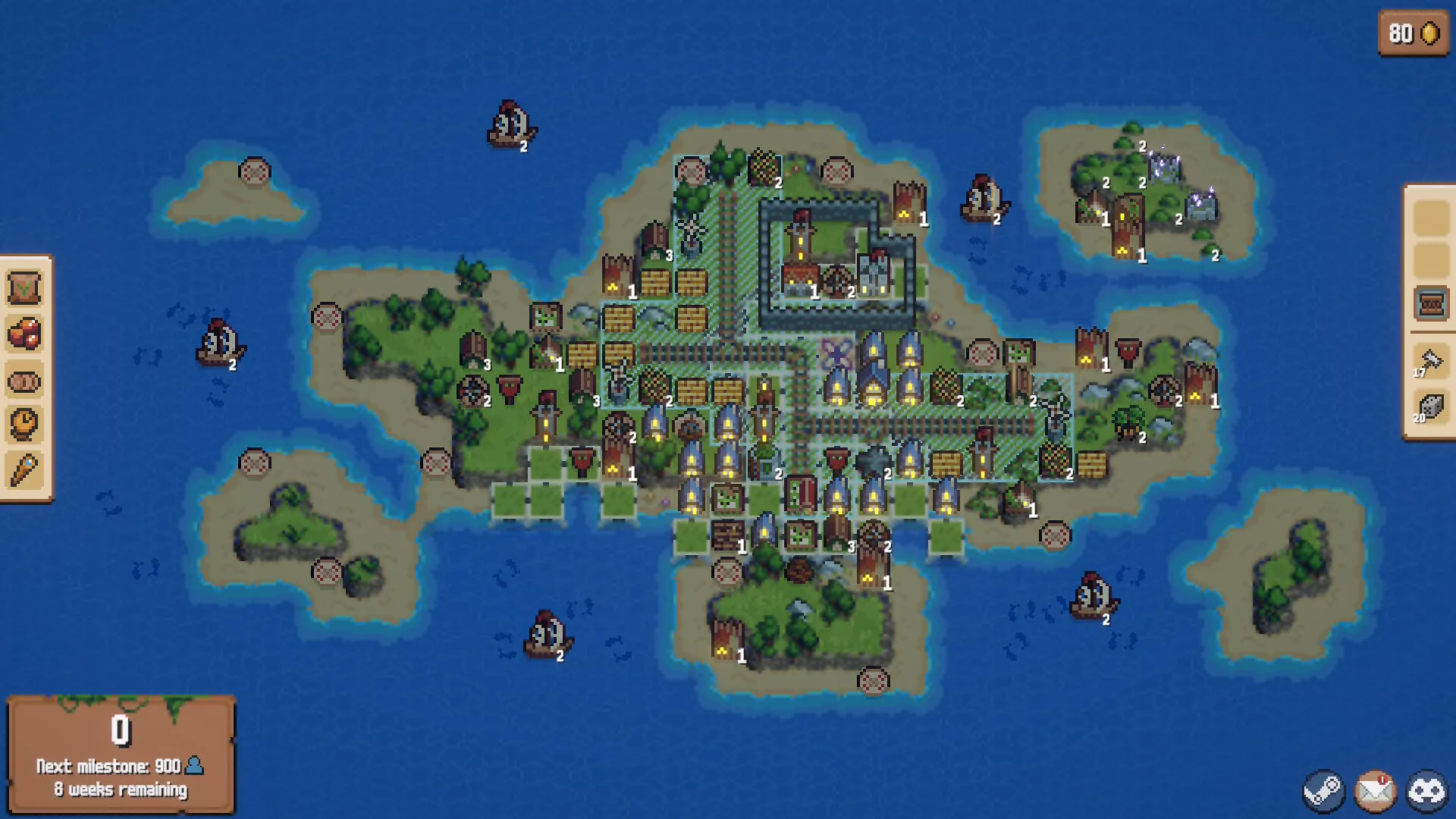
Read the island before filling it
A procedural island gives you limited placement space, while buildings, ships and resources create the board you must develop. Keep a usable lane for the interaction you are actually building instead of packing every early tile.
Common beginner questions
What is the goal of a Combolands run?
Official screenshots show a population target and a limited number of weeks. You place building cards and stack effects to advance through city milestones before the run timer ends.
How long is a Combolands run?
About 30 minutes is the safest public estimate: the official store markets 30-minute bursts and one cited launch review reports a run at about that length. It is an estimate, not a fixed real-time limit.
What does Gold do in Combolands?
Demo v9 notes say Gold can refresh quests and that dismissing a shop costs 3 Gold. Manure grants +1 Gold when removed. Other launch uses are not yet fully documented.
What does the Council button do?
An official screenshot shows a Council button, while the June demo notes mention City Council quests. The complete Council interface is not explained in the current source set.
How do ranks change a run?
Full-release players describe Explorer through Regent, with added difficulty as ranks rise. Winning at the highest unlocked difficulty opens the next one. The pre-release Baron/Count screenshot is a dated example, not the current selector’s rank list.
Does Combolands have a tutorial?
Yes, but it is intentionally light. A developer says the full game has more directed tutorialization than the demo while deliberately leaving exact building-placement decisions to the player.
Sources & version
Official Combolands Steam page ↗
Crux Games developer reply about tutorialization ↗
Current-release claims and older Demo facts are kept separate. Where public sources do not publish a complete rule set, this guide tells you what to read in the live interface.